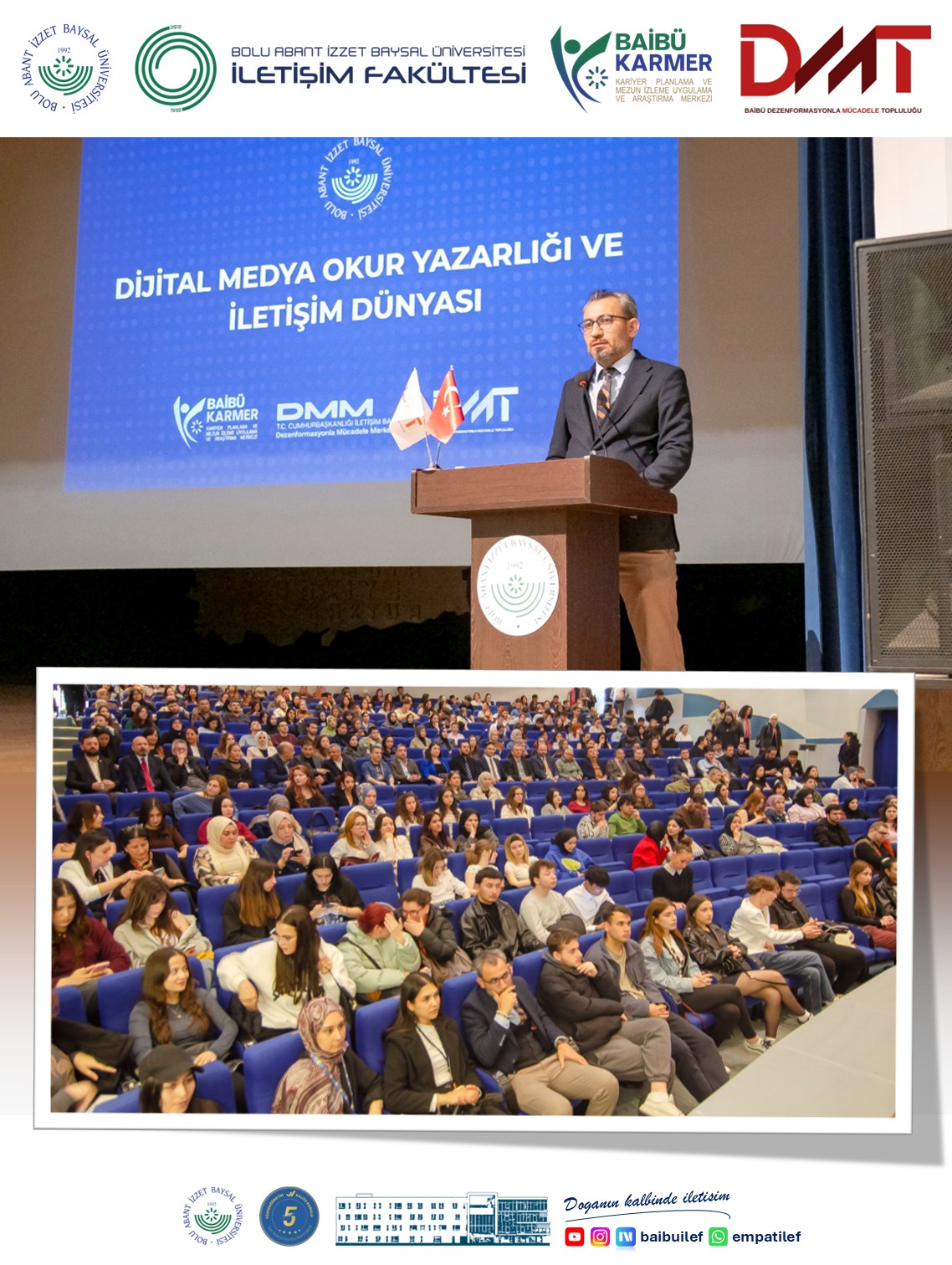

With the support of the Presidency's Communications Directorate's Disinformation Combat Center, our University's Career Center (KARMER) and the Disinformation Combat Community organized a program titled "Digital Media Literacy and the World of Communication"; the program hosted distinguished individuals who have worked for many years in leading media organizations in our country.
The program highlighted the fight against disinformation and the ethical boundaries of the digital world in an era where information spreads rapidly but its accuracy is more critical than ever; it also presented examples from behind the scenes of news production.
The program, held in the Blue Hall of the İzzet Baysal Cultural Center, was attended by Deniz Demir, Coordinator of the Presidency's Communications Directorate's Disinformation Combat Center; Vice Rector Prof. Dr. Ferudun Kaya; Dean of the Faculty of Communication Prof. Dr. Emre Tandırlı; journalist and news anchor Bora Balar; ATV Main News Reporter Yavuz Oymak; academic and administrative staff; media professionals; representatives of political parties; representatives of civil society organizations; and students.
Aleyna Akçay, President of our University's Anti-Disinformation Society, who gave the opening speech of the program, said, “Although access to information has become much easier in the digital age, distinguishing between accurate and inaccurate information has become more important than ever. We organized this event to raise awareness and to cultivate conscious individuals who question the source of information. Today, we will listen to information from our valuable expert guests on digital media literacy, communication strategies, and combating disinformation.”
Lecturer Er: “In an era where perceptions are replacing facts, accessing accurate information has become a responsibility.”
Murat Er, Academic Advisor of the Society for Combating Disinformation and Lecturer at KARMER, noted that in the postmodern era, where perceptions have replaced facts and truth must be sought, accessing, questioning, and interpreting accurate information has become a greater responsibility than ever before. He stated, “In today's world, where shared information reaches millions in seconds and fast-paced agendas are consumed just as quickly, digital media literacy is not only a technical skill but also, along with critical thinking, an indispensable part of 21st-century competencies.”
Demir, Coordinator of the Center for Combating Disinformation: "Disinformation is a phenomenon that has existed throughout history."
Deniz Demir, Coordinator of the Presidency's Communications Directorate's Center for Combating Disinformation, emphasized the danger of disinformation in her speech, stating, “We see that many international reports frequently refer to disinformation as a national security issue for states. We can say that the world faced the phenomenon of disinformation even more during the pandemic. Again, we see that the first steps in this regard were taken in the international arena during this period. Disinformation, although in different variations, is a phenomenon that has existed throughout history. Today, only the mass media, the areas of use, or the methods of its application have changed or diversified.”
"We experienced the importance of combating disinformation during the February 6th earthquakes."
Demir emphasized that Turkey was among the first countries to respond institutionally to the fight against disinformation, stating, “I think this is a very critical fact. It is extremely valuable that our country reacted so quickly to a phenomenon that is seen as a global risk and threat. Our country's institutional fight against disinformation is manifested through the Disinformation Combat Center, which operates within our Presidency of Communications. Our center was established in August 2022, and unfortunately, shortly afterward, we experienced the devastating earthquakes of February 6th. During this earthquake period, we saw how effective and local this institutional center's response was in combating disinformation.” He then went on to describe the efforts made in Turkey to combat disinformation.
"It is our social responsibility to ensure that accurate news spreads quickly."
Demir pointed out that periods of crisis and disaster are when disinformation is most prevalent, stating that negative news spreads more widely during these times, attempts are made to undermine the bond of trust between state institutions and citizens, and an atmosphere of chaos, fear, and anxiety is sought to prevail in society. He underlined that the rapid dissemination of accurate news is a societal responsibility in combating disinformation and emphasized the importance of media literacy.
News anchor Bolar informed students about the AA fact-checking hotline.
Following the speeches, journalist and news anchor Bora Balar gave a presentation on "Reality and Perceptions in the Age of Disinformation: The Importance of Digital Literacy." He emphasized the importance of accessing accurate information from reliable sources, warned students that not everything seen on social media is true, and informed them about Anadolu Agency's fact-checking hotline. He presented examples of disinformation news and images from the US elections and the Iran/US-Israel conflict; he explained in detail what should be done in such situations. He also informed the students about the importance of the correct use of the Turkish language.
ATV reporter Oymak explained the importance of journalism.
ATV Main News Reporter Yavuz Oymak gave a presentation titled "Disinformation and Perception Management from a Main News Perspective." He stated that a journalist is someone who enters a building to film an explosion instead of fleeing, emphasizing the importance of journalism as a profession and offering advice to students who want to pursue it. In his presentation, he touched upon the harm social media has inflicted on the journalism profession and explained the importance of digital journalism.
Following the question-and-answer session, protocol members presented plaques and certificates of appreciation to prominent figures in the media industry. Students were given information about the sector in the foyer area. The program concluded after a group photo session.
Source link: https://ajanda.ibu.edu.tr/habercilikte-dezenformasyonla-mucadele-konusu-ele-alindi/